
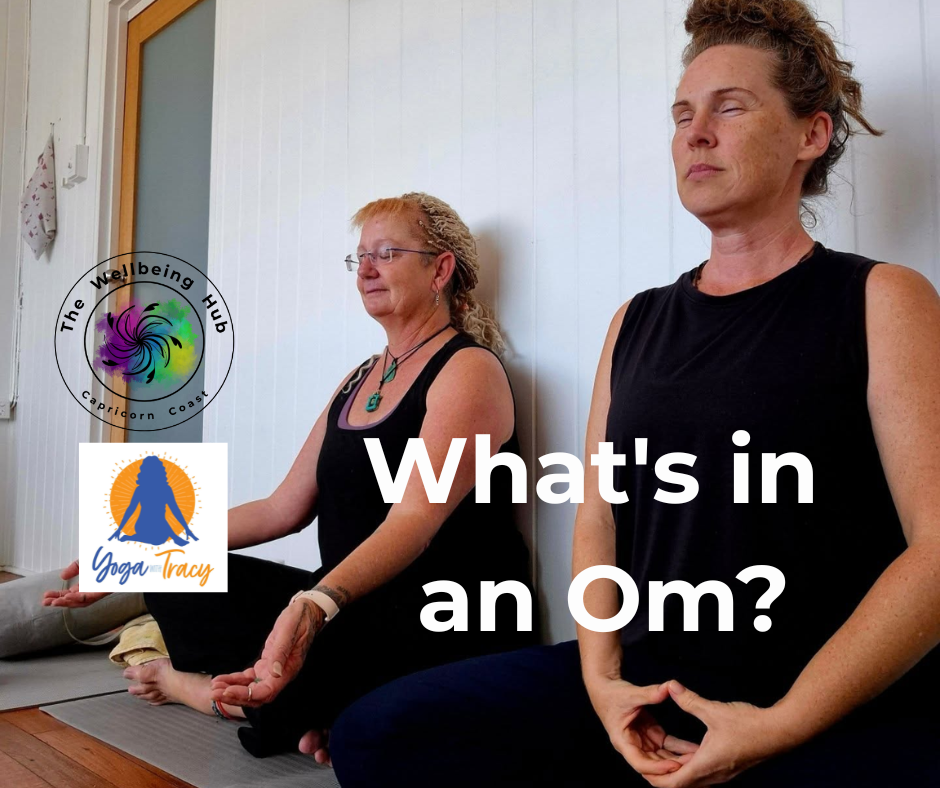
Recently at a Mindful Yogi session (a free event I run monthly at the yoga space), I asked the group:
Does anyone know why we chant OM?
Does anyone fully understand the meaning of the OM?
So here’s an overview of what we discussed.
Unfortunately this article cannot possibly convey the raucous laughter that ensued as we practiced chanting out loud!
In yoga, chanting “Om” (also spelled “Aum”) is a practice rooted in ancient traditions to harmonize the mind, body, and spirit, fostering a sense of unity and peace, and connecting practitioners to a deeper spiritual understanding.
It is considered a sacred sound and a representation of universal oneness and connection. It’s also said to be the sound of creation and all vibration. It connects us with the divine and our higher self.
It is, on its own, a mantra but is also a seed syllable: Om Shanti or Om Namo Guru Dev Namo
Side note quote: A seed syllable (in Sanskrit, “Bija mantra”) is a single sound or syllable believed to contain concentrated spiritual energy or essence. In the context of chanting or meditation, seed syllables are used to invoke specific states of mind or divine qualities. They’re like verbal “seeds,” containing the vibrational essence of a broader spiritual idea or intention.
“Om” is considered the primordial sound, symbolizing universal creation, unity, and divine consciousness. It’s often the foundation of chants.
“Shanti” means peace, and when paired with Om (e.g., “Om Shanti”), it becomes a mantra for invoking inner and outer peace, balance, and tranquillity.
Chanting “Om” can create vibrations in the body that promote relaxation and calm.
It can help to foster mindfulness in daily life, reduce stress, and promote a sense of well-being.
The chanting can help to extend the exhale, which can trigger the parasympathetic nervous system or put simply the relaxation response.
It can also help to create a sense of unity and community within a group practice
And, of course, science is finally catching up with ancient wisdom and says that chanting Om does affect the vagus nerve, reduces stress, and creates a sense of harmony within the mind-body system.
How incredible.
So open those vocal chords in your next class and enjoy the many benefits of OMing.
See you on the mat,
Tracy
You can find Tracy on Facebook & Instagram

Leave a Reply